
Two days with room to breathe
Two days in Fontainebleau: forest, château and villages
A good weekend pairs one memorable forest outing with one inhabited place each day. Choose one side of the massif, keep a wet-weather alternative and save the other areas for next time.
The overfilled-weekend trap
On a map, Barbizon, Franchard, Rocher Canon, Thomery and the château appear to fit inside a neat circle. On the ground, roads skirt the forest, sand slows every walk and each village deserves more than a twenty-minute stop. Two days are enough to understand Fontainebleau, but not to collect every famous name.
Keep one rule: one forest area and one inhabited place each day. That place might be the château, Barbizon, Thomery or Samois. It offers lunch, a story and a fallback if the forest closes. The woodland provides unhurried time. Together they make a coherent day.
Before booking a visit or choosing a loop, check the ONF map of areas currently accessible. The July 2026 fires left closures and diversions that continue to change. Build your weekend around what is open now, not a list saved last year.
Where you sleep also changes the pace. A place near Fontainebleau-Avon simplifies a weekend by train, while Barbizon suits the painters’ itinerary. Read Where to stay around Fontainebleau after choosing your two days, then check the real journey between your accommodation, station and first forest trailhead.
Plan 1: a first car-free visit
Day 1, Avon, the park and château
Leave the train at Fontainebleau-Avon and begin gently. The tourist office publishes the Along the water route from the station into the park and gardens. It connects nine viewpoints that explain how water serves the estate. Download its roadbook and GPX rather than following only the signs for the town centre.
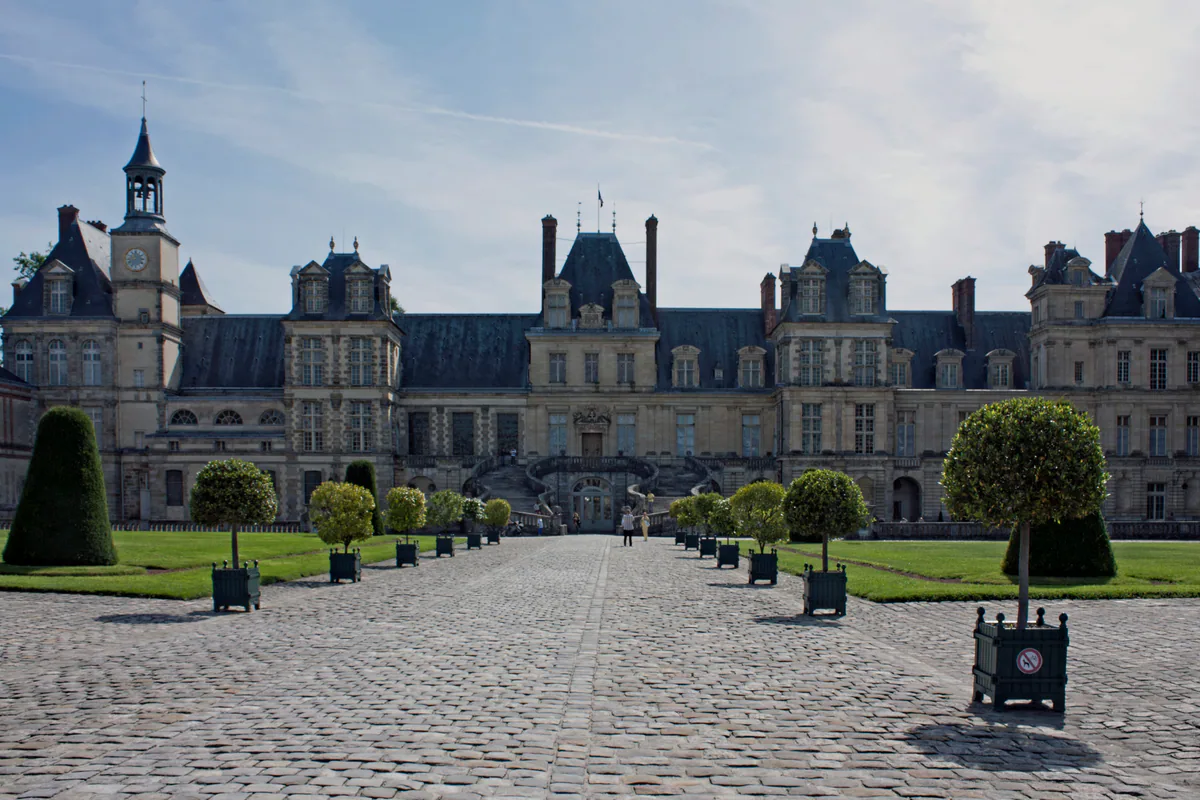
Give the château a real block of time. Use the official Château de Fontainebleau website for that day’s hours, open spaces and tickets. The apartments, courtyards, gardens and park have different rhythms. If you tour the interior, resist adding a major afternoon hike.
Finish in central Fontainebleau or return through the park. This first day comfortably absorbs a later arrival, a bag to drop off or a shower without sacrificing the main visit.
Day 2, choose Thomery or a traverse
For a manageable day, take line R to Thomery and follow Seine, walls and forest, a published 9 km yellow loop taking around three hours, with an alternative start at the station. It links the Seine, quarry-workers’ paths and fruit-growing walls. Our Thomery guide follows the useful junctions and leaves time for the village.
Experienced walkers can replace this loop with a published station-to-station route. Let the roadbook, available daylight and return trains make the choice. Our walks from railway stations guide compares the traverses without pretending they are easy strolls.
Plan 2: sandstone and painters with a car
Day 1, Cabaret Masson then Fontainebleau
Cabaret Masson is a compact introduction. The AFF loop covers 2.6 km and allows around two hours for its six stops. They introduce a notable oak, the Cyclops boulder, a Denecourt passage, lichens, a cave and the part played by dead wood. Read our Cabaret Masson directions before leaving because walking marks and climbing arrows meet in this area.
After the walk, go into Fontainebleau for lunch and a château visit. If the day is already moving on, keep to the courtyards, park and town instead of rushing the interior. Do not add Cassepot merely because it appears on the same map. Its 3.7 km yellow loop has its own navigation and deserves another half-day.
Day 2, Barbizon at walking pace
The Barbizon painters’ trail is a published 6 km yellow loop taking about two hours. Its eleven stops pass through the village and by artists’ houses, the Millet-Rousseau medallion, the Elephant boulder and old stands of trees. It gives the day a structure without confining the visit to a single museum.
Walk in the morning, then choose Auberge Ganne, a studio or the galleries according to their actual opening times. Our guide to the forest near Barbizon explains the conversation between the village and woodland edge. Do not set off for Thomery or Moret afterwards. You would spend the end of the day making connections.
Plan 3: boulders, water and village
Day 1, Rocher Canon and Mare aux Évées
The Rocher Canon and Mare aux Évées trail brings two very different landscapes into one published 5 km route: sandstone formations on one side, then a pond and star-shaped ditches on the other. Bald cypresses, old forest avenues and boulders provide plenty to notice without moving to a second area.
It remains a real hike despite the modest distance. Rocks, sand and junctions need time. Use the current roadbook and our Rocher Canon guide, then keep the afternoon for Bois-le-Roi or a Seine riverside, depending on your transport.
Day 2, Thomery instead of another boulder field
The Thomery loop changes the mood completely. After pines and rocks, you walk among forest, railway, village and river. The Longs Sillons lanes and old cultivation walls show why the landscape is more than a natural backdrop. That contrast gives the weekend more shape than two sandstone areas crossed in a hurry.
Adapt the two days to your group
With young children, keep the château park for the first day and one compact loop for the second. Cabaret Masson works for children already comfortable on uneven ground. For a pushchair or wheelchair, look at officially designated accessible trails and then confirm the surface condition. Our family-walk guide explains the differences.
After heavy rain, favour the village, château and improved paths. Wet sandstone is slippery for walkers and too fragile for climbing. In high winds, replace the forest with heritage visits. A fallback chosen the night before feels like a plan, not a failed day.
For strong walkers, a single station-to-station traverse can be the centre of day two. Do not combine it with a full château interior visit. Keep day one light and verify every part of the route after recent closures.
Where meals, bags and the return fit
Buy water and picnic food in a town or village before entering the trees. Do not expect a shop in the forest. If you travel with luggage, ask your accommodation where it can be left. A suitcase should never become the reason for improvising a walk along a road.
On the final afternoon, choose something near the station you will use. Fontainebleau-Avon pairs naturally with the park, Thomery with a village walk, and Bourron-Marlotte with time in the streets after a traverse. Check the official station-accessible itineraries and live Île-de-France Mobilités times before fixing the order.
Two well-grouped days leave a clear memory: water and stone, the forest and the people who explored it, a great monument and a village. They also leave a reason to return, which is much better than a weekend spent ticking off car parks.